
Stability and agility, two sides of the same coin: that of digital transformation
The Covid-19 pandemic has strongly contributed to accelerating the evolution of the technical infrastructures of companies. A fast-paced digitization process, sometimes at breakneck speed, should not however overshadow two very important aspects which are: stability and agility. As the technological boundaries keep getting pushed back by the cloud, Big Data, Artificial Intelligence and the Blockchain, companies need to be supported efficiently in their transformation, making sure their IT system materializes accordingly. Managed Services are gaining much more traction as a means to achieve these objectives of stability and agility.
The Cloud and Hybrid Models, New Boundaries and Challenges
Using the Cloud as the core component of the IT system of companies is nothing new and has been the norm for a couple of years, but Covid-19 has significantly accelerated this trend. The pandemic served as a catalyst in this transition especially when it came to setting up the infrastructure to allow remote working. This transition was not a smooth ride for the different teams, the IT department, and the business overall.
In a more or less natural way, a hybrid model based on an in-house (on premise) IT system has surfaced to which different Cloud peripherals have been added. In this volatile world, companies need to ensure that their IT operations are future-ready, stable, and agility enabled to meet the business challenges they will face.
IT Architecture at the Heart of Industry and Business Models
The ongoing process of adapting IT to technological and organizational challenges is pivotal when going digital. This is not just an IT related concern but a concern that needs to be appreciated at all levels of the organization. Industries are changing, new collaboration models are being introduced within and outside the company, the economic situation is volatile with the constant emergence of new technologies: change management is a long-term dynamic.
How do you keep a company together (its core business, entities and so on…) while gearing up your organization to lead it into the future? How do you make sure you cater to all the specifics of the different businesses while also providing and coordinating that cross-functional common denominator (CRM, logistics, etc.)? These fundamental questions, which place agility at all levels of the business, lie at the heart of the digital transformation strategies. While doing so they also need to drive and secure overall stability and provide maintenance that are just as critical. Agility does not come easy when you are trying to deliver best-in-class service for efficient, secure and reliable IT operations. The challenge is to make both sides of the coin work together, both in the short and long term.
Managed Services – the linchpin of Digital Transformation of businesses!
hree essential benefits: security, availability and performance.
Managed Services, as they are called, are designed to help measure these challenges converting the technical infrastructure into a key success factor. Having a qualified and trusted partner that provides customized offerings, a cost-effective budget with a whole host of managed services helps support the entire IT system from the deployment phase to maintenance right through the upgrades. IT teams can then focus on higher value-added tasks!
They also acutely support the different business needs, help take into account and manage the legal and regulatory changes to come, and help internal teams work towards new strategic missions.
How to Leverage Managed Services in Times of Crisis
With the sanitary crisis and all the restrictions that came with it, i.e. not allowed to go to coffee shops, hotels and restaurants, these businesses had to rethink the way they do business. Transforming one’s business into an “all-digital” model is not an easy thing to do. With the sales channel changing, it necessarily has an impact on the logistics and the relationship with customers. Internal tools like payroll management need to adapt to the remote working landscape. Managed Services help these customers focus on their core business while the different IT teams are tasked with overhauling, maintaining the IT system delivering an agility-enabled transformation project.
Another sector that has been greatly impacted by the Covid-19 crisis is the aeronautics industry. The core business of one of our customers was purely and simply interrupted for several months. While the company was rethinking its business strategy developing new revenue streams (in logistics and the transportation of masks and essential materials, for example), it had to ensure the sustainability of its IT system to stay in the game. Managed Services helped this customer be agility-ready and adapt his value proposition accordingly while benefitting from high-performance continuity of service that factor in the rapid internal changes.
Managed services bring tangible and efficient support to the transformation of an IT system. The maintenance of hybrid infrastructures and business applications should not hinder the ongoing evolution of the IT system…Wouldn’t it be the right time to accelerate digital transformation in complete confidence, with a cost-effective budget, and leverage the best applications and technical solutions on the market?
The IT System Has to Support the Business and Ward Off New Potential Risks and Threats
Interview by Global Security Mag with Cyrille Duvivier, Customer Care Strategic Director at Prodware
Prodware is a Digital Services Company that was founded in 1989 and that has expanded its footprint in Europe mainly selling Microsoft solutions. Prodware addresses IT security with a full range of solutions designed to protect its customers at a time when cyber crime is on the rise with cyber attacks happening all the time: user and terminal security, perimeter security, data security, security audits, SOC organization (Security Operation Center). For Cyrille Duvivier, Strategic Director of Customer Care at Prodware, the IT system has to support the business and ward off the new potential risks and threats.
GSM: Can you please introduce your company?
Cyrille Duvivier: Prodware is a Digital Services Company that was founded in 1989 and that has expanded its footprint in Europe mainly selling Microsoft solutions. Today Prodware boasts 1300 employees and generated 172m€ in turnover in 2020. The Infrastructure, Cloud &t Digital division caters to SMEs and Mid-Market organizations essentially and makes up 10% of the group’s turnover.
GSM: What leading range of services are lined up for 2021?
Cyrille Duvivier: The Cloud and Infrastructure business calls for agility in order to adapt to customer requirements and to new opportunities provided by our partners. Our historical expertise is based on Microsoft solutions and relies on the design, implementation and support of Information Systems for our customers’ critical business applications. In continuing with our traditional “On premise” approaches, we developed our own private Cloud more than 10 years ago. Today, we complement our private Cloud with Microsoft Azure, the open and flexible public cloud platform with cloud services. Prodware addresses IT security with a full range of solutions designed to protect its customers at a time when cyber crime is on the rise with cyber attacks happening all the time: user and terminal security, perimeter security, data security, security audits, SOC organization (Security Operation Center).
Of course, we fully leverage Microsoft’s ecosystem, whose main takeaway is providing a fully integrated security layer regardless of the services used: On premise, Azure, Office 365, Power Platform, Dynamics.
GSM: What is your role in the organization?
Cyrille Duvivier: I took over the management of the Infrastructure, Cloud and Digital department about 8 months ago after having founded it more than 20 years ago. Meanwhile, I have held various positions within the group, including Head of the Excellence and Quality department for a few years, then Director of Customer Care, where I reorganized the entire TMI and TMA Managed Services for the group’s countries: organization, processes, tools and value proposition. With the latter now on track, I decided to return to my first love, i.e. infrastructure, whose fundamentals have not fundamentally changed since it is still all about serving our customers while complying with their IT strategy, their budget and their operational requirements. What is new is the increased use of outsourcing (Cloud and Managed Services) so that customers can better address the complexity of their hybrid infrastructures without compromising their security.
GSM: Can you explain how services are set up within your organization?
Cyrille Duvivier: In France, Prodware has four business lines that are supported by our Infrastructure, Cloud and Digital division: CRM and ERP business applications with the Dynamics suite from Microsoft; Sales and Management, Finance and Payroll solutions from Sage and Autodesk for engineering and architectural firms.
GSM: What would be your message to our readers to conclude this interview?
Cyrille Duvivier: The connected and immersive world we now live in holds great promise and opportunity for both individuals and organizations. In this Eden of possibilities, we are now witnessing cybercrime as it depicted in science fiction novels and movies only just a few years ago. The role of CIOs, and by extension that of Prodware, is centered around the IT system: not only must the IT system support the business but also has to make sure it keeps these new cyber risks and threats at bay.
How to prevent cyber crimes
Awareness about cybercrime within organizations is still somewhat recent. Today, it is one of the fastest growing forms of crime worldwide.
Cybercrime has become more professional, especially with increasingly structured organizations that generate very significant revenues of up to: $1.5 trillion per year.
Cutting-edge cybercrime
Cybercriminals have developed a high level of expertise in the computer technologies we use everyday and know everything there is to know about their flaws. Their approach is obviously based on leveraging these flaws but above all, they resort to social engineering techniques to coax users into sharing confidential information.
They then gradually work themselves into the IT system and compromise the security of the entire organization. On average, SMBs and mid-market companies that are victims of cyber crimes have their operations stalled from 1 week to a whole month, their sensitive data exposed and suffer a financial loss of €200,000.
Companies have an obligation to protect their own data either by contract or because they are legally bound to do so. Data protection is a business imperative for both users and organizations and should be at the heart of a company’s strategy.
When hackers break into a company’s system, the consequences for that organization are often dramatic because the cyber criminals destroy, corrupt or steal personal or sensitive data (list of customers, pricelists, trade secrets) to either leverage that information or sell it on the Dark Web.
Their second source of revenue is cyber extortion which consists in conducting ransomware attacks on companies; they get hold of or threaten to destroy a company’s sensitive data including their data backups leaving these companies completely at the mercy of the hackers.
Beyond the damage caused and the ransoms sometimes paid out, cyber crime shows just how vulnerable and exposed these companies are and can also ruin their reputation.
Types of cyber crime
- Phishing: tactics include deceptive emails, websites, and text messages to steal information.
- Spear Phishing: email is used to carry out targeted attacks against individuals or businesses.
- Baiting: an online and physical social engineering attack that promises the victim a reward.
- Malware: victims are tricked into believing that malware is installed on their computer and that if they pay, the malware will be removed.
- Pretexting: uses false identity to trick victims into giving up information.
- Quid Pro Quo: relies on an exchange of information or service to convince the victim to act.
- Tailgating: relies on human trust to give the criminal physical access to a secure building or area.
- Vishing: urgent voice mails convince victims they need to act quickly to protect themselves from arrest or other risk.
- Water-Holing: an advanced social engineering attack that infects both a website and its visitors with malware.
How to protect against cyber crimes?
Cyber Security strategies usually stem from an Information Systems Security Policy (ISSP), which is the equivalent of a “Master Plan” in terms of IT security. It is, in principle, implemented by the Information Systems Security Manager (ISSM) who defines the goals aimed for as well as the different means and techniques that will be used. Here are some examples:
- Antimalware & MDM (Mobile Device Management): This first level of protection is essential. Antimalware or MDM solutions such as Windows Defender, Trend or Microsoft Intunes secure and control corporate or personal terminals and thus allow the effective application of a global security policy of the “Conditional Access” type, possibly based on MFA (MultiFactor Authentication) and other criteria such as connection times and locations for example.
- Least privilege and Separation of duties: The administrator accounts manage all of the company’s strategic IT assets: on premise or Cloud, hardware or software. As a result, these accounts, which oversee the corporate directory, must comply with certain best practices such as complex and renewed passwords, multi-factor authentication, segregation of duties and the principle of least privilege.
- Cyber awareness program: To help build a culture of security in the workplace and foster a sustainable change in behavior on these issues. An internal security awareness campaign must be run to get all the company employees onboard. It is the sine qua non for significantly reducing user-generated risk.
- IT Charter: An IT charter also ties into the ISSP. It outlines the rights and obligations of users with regard to the Information System.
Cybercrime poses a real threat to businesses today. Businesses are stepping up the fight against cyber crime.
Hackers, unfortunately, like dopers in sports, are often one step ahead of the game. Nevertheless, we know more about the way they operate today. We can do much more to reduce the risks by staying organized and using the appropriate technologies to combat cyber crime.
With an efficient cybersecurity policy, companies can fend off cyber attackers and not fall prey to their scams and online fraud.
Back to basics: Tips for building a successful CX program
Whether you are a CX professional or trying to become more aware of the experience being delivered to your customers, these five practical tips will surely be a great source for kickstarting a CX program!
Essential points for starting a CX initiative
A CX initiative can have several different initiation points, but in all cases, it needs to start with the conviction that customer experience is the key to keep the company in line with market expectation and customer needs. This goes first through a management buy-in and a CX programme clearly defining the goals and KPIs that will be used to measure the process.
Once the base is in place, the first step would be to select the right tracks by running a CX maturity assessment. This part of the process should help in detecting the areas where the organization needs to invest its efforts in order to progress towards the development of a customer-centric DNA.
Keeping the organizational structure in mind
Every business needs a dedicated CX team to manage the practices needed for the CX program operation. However, the team should only handle and use the right methodology, not be the owner of the action items.
The Product/Service managers are the ones that need to take responsibility, monitor the execution, and refine the journey in predefined milestones. On the program execution level, it is required to have a CX committee that will oversee the progress of the program, break the organizational silos, by arbitrating disputes when conflicts arise.
Lining up the CX strategy and business goals
A CX strategy is an approach that comes as support to the business goals of the company. Since companies exist to make a profit, there needs to be a clear understanding of the way the improvement in customer experience will contribute to the achievement of positive business results.
From a practical perspective, after the journey mapping exercise is over, and we go into the execution phase, it is necessary to start measuring the predefined KPIs. This action will allow for estimating the impact that the CX actions have on the improvement of customer satisfaction, as well as on the bottom-line results (revenue/profit). Popular CX metrics are CSAT, NPS, CES along with traditional business metrics such as EBITDA, conversion rate, SLA, and others.
Continuous refinement for a strong program
Most organizations fail when running CX initiatives because they abandon the program after the initial work has been conducted. I would argue that quite the opposite is imperative. Running a CX program requires continuous refinement of the customer journeys and action plans if one wants to be in line with market trends and customer expectations. The best way to keep a CX program alive is to invest in the development of a customer-centric DNA that will become like second nature for employees, integrated into their daily way of working.
Final points to focus on when building CX engagement
If organizations want to deploy a successful CX strategy, they should focus on repetitive operations when building the CX engagement. To start creating CX awareness, you can easily deploy a project on a small scale with a group of “CX believers”, share the impact and benefits, and then expand at a larger scale to the rest of the organization. In this way, you get to establish a successful CX program that maximizes the impact of customer-centricity on the daily operations of the business and its KPIs.
Experience: from expertise to emotions – Alain Conrard in Economie Matin
Article published in French news site Economie Matin by Alain Conrard, Prodware CEO
The culture of innovation relies, in large part, on the positive appreciation of disruption and distortion.
With the fourth industrial revolution, the one we are in today, i.e. digital transformation, we have ushered into a system where much of what made us strong yesterday is precisely what is weakening us today. While innovation does push back the boundaries of things and places, it also changes the meaning of words. And such a change in meaning can be seen in this one specific word, a term that has become one of the key words of the digital revolution: the term is “experience.”
The meaning of “experience” used to allude to the industrial sector (a good employee needed to have experience), whereas the term now almost exclusively refers to the heart & soul of the shopping process (the consumer lives the experience of getting acquainted and engaging with a brand or product).
Experience: it is all about meaning
It was an old word. It suggested long periods of time, painstaking work and effort, gaining mastery in a manual skill or in decision making all garnered over a significant period of time: working consisted in acquiring experience. And “having experience” meant having spent the required time doing, redoing and excelling in a skill. Experience was a guarantee: a guarantee that a person who has spent a certain amount of time in a given field or practice was much more well- versed than someone who did not. Experience is what sets apart a qualified worker from an apprentice: an apprentice acquires experience. What is a CV (which literally means a “course of life”) if not a document certifying the experience one has acquired? Experience was perceived as a positive professional timeline: the time it took to acquire, soak in and hone one’s skills to perfection.
For a very long time therefore, we have appreciated experience as a basic logical equation stipulating that more and more experience equals better performance and efficiency. Well that is no longer true! Experience, as a metric for professional proficiency developed over time, which was a person’s track record and represented their potential value on the market for a given position, is nowadays not the only performance metric around. In fact, experience, like other acquired skills, is even likely in certain fields, to be a disadvantage for the person looking to leverage that experience. In today’s society where innovation has become this permanent dynamic, praising change as an imperative need, experience is synonym for ‘traditional’ or ‘immobility’: it suggests something of the past. Of course, in certain fields experience is here to stay and cannot be replaced: i.e. in the medical field, in surgery or management for instance. But many of what used to be bastions of human experience are being challenged by the outstanding performance levels of robotics and machinery. This suggesting that a new form of cooperation, unheard of before, is to be expected in the future – and likely beneficial if well orchestrated – between experience and creativity, i.e. between tradition and creation.
Nevertheless, experience is at the heart of the innovation dynamic. It is even one of the key notions. But in actual fact it is not the same experience we are referring to. Experience today, far from the old meaning, refers largely to a sense of astonishment and discovery. The evolution of the word even goes as far as depicting the true nature and philosophy of what innovation is. The term describing the perfect execution of a habit and acquired know-how, has become one of the main innovation markers now describing the utmost in novelty and in embracing the unprecedented. The term is to be understood as the way we feel things: experience as an empirical proof of sensation. Where experience once meant putting in the hours, practicing over and over, in order to perfect a manual skill as smoothly as possible, it is now akin to the meaning of ‘causing turbulence.’ Today, it is all about providing a stellar consumer journey when engaging with a brand or product (digital contents, stores, events, technical support…): navigating smoothly and easily so that satisfaction, a criterion that is constantly measured, is at its best.
The two meanings of experience refer to a journey but two different kinds of journeys: one relates to giving up one’s immaculate slate for a lifelong skill building itinerary and the other is a shopping spree where you actually need to embark with a clean slate for a wild and unexpected ride.
Before, you acquired experience and today, you live an experience. It used to be about knowledge (or know-how); it is now all about emotion.
Consumer experience: a journey full of surprises
What we call experience today is not about reproducing one’s skill set indefinitely but it is the exact opposite: it is the “wow effect” of novelty. It is the sensual encounter between a consumer and a product or service at every touchpoint of the brand’s customer journey. By definition, that same experience cannot be reproduced indefinitely and needs to be enhanced and “rejuvenated” lest the product or service gets perceived as “passé.” Indeed, every user experience needs to be reinvented to reignite that magical effect of the product or service. And this is required even if the innovation at hand is not disruptive but stems from incremental and continuous improvements.
Thus, the resulting user experience that a brand provides its customers, through its products and services, is an ever more omni-sensory journey. The consumer experience is actually thought up as an actual journey (Customer Experience Journey), a highly emotional journey with every step of the way having to be memorable. This “customer journey” applies both to in-person shopping experiences (brick-and-mortar stores) and online shopping experiences (posting content across its different communication channels and touchpoints: websites, Facebook, Instagram, Twitter, blogs, and so on).
It is like engaging a “first-time” customer in a way, because the “wow” effect can only work with new encounters. Being able to renew the user experience comes down to exposing the customer to novelty, refreshing his journey, i.e. emotionally engaging the customer with content, products or services provided by a brand.
This new meaning of the word “experience” has taken over the central notion or idea of usage. And this shift, for a large part, is to be applauded because it contributes to putting the human being at the heart of the innovation dynamic.
Emotionally engaging your customers: the most rational choice
We have finally realized that economic players are not just rational beings behaving coldly and perfunctorily, but people with feelings. Introducing the Consumer Experience at the core of the economic model changes everything irreversibly. Experience, now being the main and most important focus, underscores that the most reliable economic trigger is emotion. So being realistic today means trusting a once, very unstable criterion, upon which to establish a commercial approach.
The emotion felt or experienced by a consumer is a way for a brand to develop brand stickiness. The challenge for manufacturers is to figure out the right customer-centric strategy that will generate and drive that emotion. It is all about the 4 “Es”: Experience (a memorable journey at every touchpoint), Emotion (the “wow” effect that the brand delivers), Engagement (consumers feel understood & relate to the brand), Exclusiveness (consumers feel special). Because consumers are spoiled, informed, sometimes too informed, swamped with information – and are easily jaded as a result –, they now call the shots and switch from brand to brand as they please. Customer loyalty is therefore hard to come by. You need to captivate to convince; and drawing their attention is becoming even more challenging with the increasing number of offerings and services of all kinds cropping up everywhere. Now, more than ever, manufacturers need to foster and develop a very strong relationship with each of their existing and potential customers. Only a stellar and unique experience can help tip the scale. Moreover, all things being equal, a unique customer experience drives more business. The challenge is even greater in an era where time is no longer a linear concept, where work and personal life are more and more intertwined with all our traditional bearings becoming increasingly fickle.
Maximizing the customer journey and experience is pivotal in developing customer loyalty. Providing a unique experience and delivering on your brand promise, way beyond the expected market standard, is the linchpin of consumer satisfaction. Consumer satisfaction must be guaranteed across the entire buy-in cycle from the discover phase to the loyalty phase. We know that emotionally engaged consumers are more loyal to a brand and are likely to become advocates enthusiastically promoting the brand. The tools and the talent are available to reach this objective. Willpower does the rest.
Emotion is one of the most powerful triggers of a human being and leveraging that aspect with a consumer experience strategy is perfectly rational from an economic standpoint. So kidding aside, let’s take emotions seriously.
Reindustrializing, Relocating…the Path to Political Innovation?
Article published in French news site La Tribune by Alain Conrard, Prodware CEO
OPINION. Talking about “reindustrializing” and “relocating” is often akin to wishful thinking and is fantasy-like i.e. like going back to a previous status quo. Is it even possible? And if so, is it something we really want to do? By Alain Conrard, CEO of the Prodware Group and President of the Commission on Digital Strategies of the METI (*).
At the end of March 2021, certain images were seen worldwide: those of a pipe that had suddenly been closed off by a valve depicted in a plumbing installation diagram. Except that the pipe in question was the Suez Canal – one of the world’s busiest trade routes – and the valve was a 400-meter long, 220 000-ton container ship that was adrift: that ship was the Ever-Given. The satellite images were striking: they clearly exposed the frailty of globalization. We suddenly realized, in total awe, that 12% of the world’s maritime trade could be disrupted by a closed-off valve. Like a giant clot blocking an essential international trade artery, the mammoth ship, stranded, put the entire distribution of goods circuit at major risk of thrombosis. These times of pandemic also made clear that the economic system was also prone to serious illness; pandemic and shortage could go hand in hand.
The Covid pandemic has brought to the surface certain weaknesses and shortcomings of industrial models related to globalization. The system of dependence on distant suppliers in complex manufacturing and transport chains leads to the loss of control and competitiveness, social dumping, and the sometimes, irreparable destruction of the local industrial landscape.
In order to break away from this dependency overload, or to find alternative solutions, or attempt to balance out a business model, we often hear a lot of talk around the concepts of “reindustrialization” and “relocalization.” Although they do not mean the same thing they are however closely related i.e., how do you go about reindustrializing without relocalizing? How can you rebuild an industrial landscape without setting up local factories or workshops in areas that globalization has systematically deserted? The French government has therefore decided to promote the relocation of production sites in the following five fields considered strategic which are: health, electronics, agri-food, telecoms and industrial inputs.
“RE ?” A New Kind of Mind Mapping
Everything revolves around the meaning of the “RE” prefix in both words. The definition of the prefix suggests “a return to the past”, or the identical repetition of an action that allows us to go over the same points. Talking about « reindustrializing » and « relocating » is often akin to wishful thinking and is fantasy-like i.e. like going back to a previous status quo. But is this even possible? And if so, is it something we really want to do? Can the word suggest a different meaning than that of conveying some sense of nostalgia, looking to the past, reminiscing, deception or impossibility? The identical reproduction of something that the “re” prefix seems to suggest is simply wishful thinking, both from a practical and logical standpoint: when trying to reproduce something of the past, we always introduce something different because we ourselves have changed and the world around us has evolved.
No matter how sorry we feel about this idea, we have to come to terms with the idea that the past is long gone. Reindustrializing as well as relocalizing can, in no way, be achieved by simply going back to the glory days of the past. Reindustrializing consists in fact in adopting completely new ways of industrializing: that of an “RE” that is in fact looking towards the future rather than towards the past – a redeployment of the “RE” prefix. Key in this new industrialization process are digital transformation and innovation. Relocalizing requires a new kind of local/global synergy (innovation can also address social issues, so why only consider technology alone?) How can we reconcile what seems to be incompatible i.e. profitability and local production? Here, too, we need to broaden our appreciation of the notion of “profitability”, which does not only relate to financial gain but also spreads through social, societal and ecological aspects. What comes out of all this is that this program, if it makes sense, can only mean thinking and acting differently.
And so, if Covid has clearly been an accelerator for relocalization, it also has been for change. In the midst of a multitude of disasters, there is at least one positive takeaway: the pandemic has forced us to look at our mistakes, roadblocks and dead ends. It has pushed us forward driving us to reinvent a new future, a new working and living environment. In short, it has compelled us to innovate.
The crisis is causing us to adopt a new mindset especially when it comes to the question of relocalization, when social and ecological benefits of short supply chains is now pretty obvious. The disruptive nature of the solutions that need to be developed to address this global and multi-faceted crisis is absolute. The need to reindustrialize and relocalize raises the question of borders: geographical borders, of course (where should consumer goods be manufactured?), but also political borders (how do you reinstate industrial sovereignty and create value within your own geography?) It is also about rethinking economic models and taking back control of our economy, and doing so through an innovation dynamic. This new mindset means “changing operating systems” to be able to think differently, according to a model that does not fall prey to the demands of globalization.
It even goes as far as considering to withdraw from this dominant economic model. This withdrawal is made possible in fact by the changes brought on by this global crisis and especially by the massive government support worldwide.
Government & Politics, Back in the Business Landscape: the Latest in Innovation
Every power in place has to have a counter-power. With that statement in mind, it is true that letting the world economy run and regulate itself was probably not a great idea in the long run. So politics is easing its way back into the game to help regulate certain economic discrepancies even though, and let’s not be naïve here, that at the end of the day it boils down to, “it’s the economy, stupid” according to James Carville, Bill Clinton’s strategist during his presidential campaign in 1992.
We are witnessing a really important boomerang effect with politics making its great comeback in the economy after 40 years of free capitalism and no state interference following the conservative revolution that brought Ronald Reagan to power in 1981 in the United States.
Up until now, we have been subjected to the macroeconomic effects of globalization, with an overwhelming prevalence of economics in decision-making that has greatly restricted the latitude of political options. Now, the ideological boundary that limits the role of the state to its strict governmental functions is collapsing. The combined effects of the environmental crisis, the social crisis and the health crisis (all three probably being different facets of the same thing) have jammed up, right in front of our eyes, this hitherto well-oiled piece of machinery. And, as if it were waking up from a long sleep, the State is called upon to intervene, urgently and with authority.
Inspired by the New Deal or the Great Society of his predecessors, Roosevelt and Johnson, the 46th American President opened the floodgates of federal funding (let’s not forget that Joe Biden’s middle name is “faucet Joe”). His administration is injecting thousands of billions of dollars into the economy, including an ambitious program of major infrastructure projects – in the term’s broadest sense: roads, widespread access to high-speed Internet, care for the elderly and the disabled, equipment and networks needed for the transition to renewable energy, etc.
In the United States, as in many countries, innovation and digital transformation are set to play a central role in these business redefinition and redeployment processes.
Innovation is based on the idea of doing away with old habits or methods in favor of more efficient means. Innovation is generally the result of a fresh look at things and providing new solutions in terms of technology. Here, the disruption resides in resorting to technological advancements in areas usually oblivious to such considerations: that of government technologies. Government authorities have long been discredited for blindly applying the monetarist and free-trade theories of the Chicago school of thought (Milton Friedman), which inspired most liberal economic policies from the 1980s onwards. Since last year, they have adopted a completely different position throughout the world and are now considered as the ultimate bulwark for containing the pandemic and countering its deleterious effects. The use of government-specific decision-making technologies in economic matters is to be appreciated as a major innovation.
Of course, one cannot expect everything from politics. In no way, should we sit around passively waiting for things to happen – nothing can replace taking action. Everyone has to try, as far as possible, to take their destiny into their own hands. Moreover, as a group, we must be willing to accept the idea that choosing means arbitrating. It means giving up some things for other things. For example, it is more than ever necessary today to join together in committing ourselves to conduct reforms that are absolutely essential in driving more flexibility.
In any case, this decision to have the State back in the driver’s seat and providing it with considerable resources appears to be a welcome leap forward. It is to be applauded as an innovative and modern framework set forth to shape the future. One of its main qualities that this initiative brings is that it fosters optimism and confidence, two notions that are essential for the smooth running of society in general and the economy in particular.
In theory, politics making its way back into the picture, can be one of the ways to help us through this crisis. Why? Because politics, at the end of the day, despite what it draws in terms of criticism and distrust, represents the voice of the people, the voice of the majority. It works toward the general interest of society like no other human initiative. Moreover, a Public Interest Policy has demonstrated more than once in history that it can help in restoring the economy, a fundamental indicator of a healthy society. And so, only strong political will is likely to foster the conditions conducive to a reindustrialization and relocalization dynamic, that can materialize into something socially significant and economically realistic in France and in Europe.
But that political will remains to be seen and needs to be utilized where necessary and applicable. So let’s make room for some political innovation!
Mid-Market Companies at the Heart of This Dynamic
It is becoming perfectly clear today that restoring sovereignty means re-empowering regions and territories in becoming more independent. Indeed, they have a pivotal role in developing and sustaining the economy. And this calls for rethinking the essential role of the entire ecosystem, notably for the mid-market companies in the regional social fabric. Indeed, 68% of company headquarters are located outside the Paris region, and 75% of its production sites are located in medium-sized cities or rural areas. As the largest employer in France (335,000 jobs created between 2009 and 2015), Mid-caps play an important social role. By creating jobs they contribute in keeping those territories alive and kicking.
Thus, beyond their strict economic function, mid-caps contribute in maintaining a safe and secure society conducive to employment and decent living conditions. They are therefore the linchpin of political stability. In this period of very high social unrest, mid-caps are a kind of a crisis extinguisher.
Reviving the country means reviving industry. With their 3.3 million employees, who represent 38% of the jobs in the manufacturing industry, mid-caps are the beating heart of industry in the different regions. In fact, one out of three mid-caps are in the industry sector. Mid-caps are a first-rate army set out to reconquer our economic sovereignty in the Healthcare, Food or Industry sectors.
So, if we intend to go ahead with reindustrializing and relocalizing our industries, we can rely on the network of mid-caps that make up the economic and industrial fabric of our country alongside the other assets also made up of SMEs and large industrial groups. We need to bring together the different market players to find robust and sustainable solutions, those of the real economy.
We have got what it takes to do just that.
We are all driven and eager to make this happen.
We have the know-how, the innovation expertise and industrial wherewithal to do all of this.
No need to play the blame game if ever we do not succeed: the key to our success lies in our own hands.
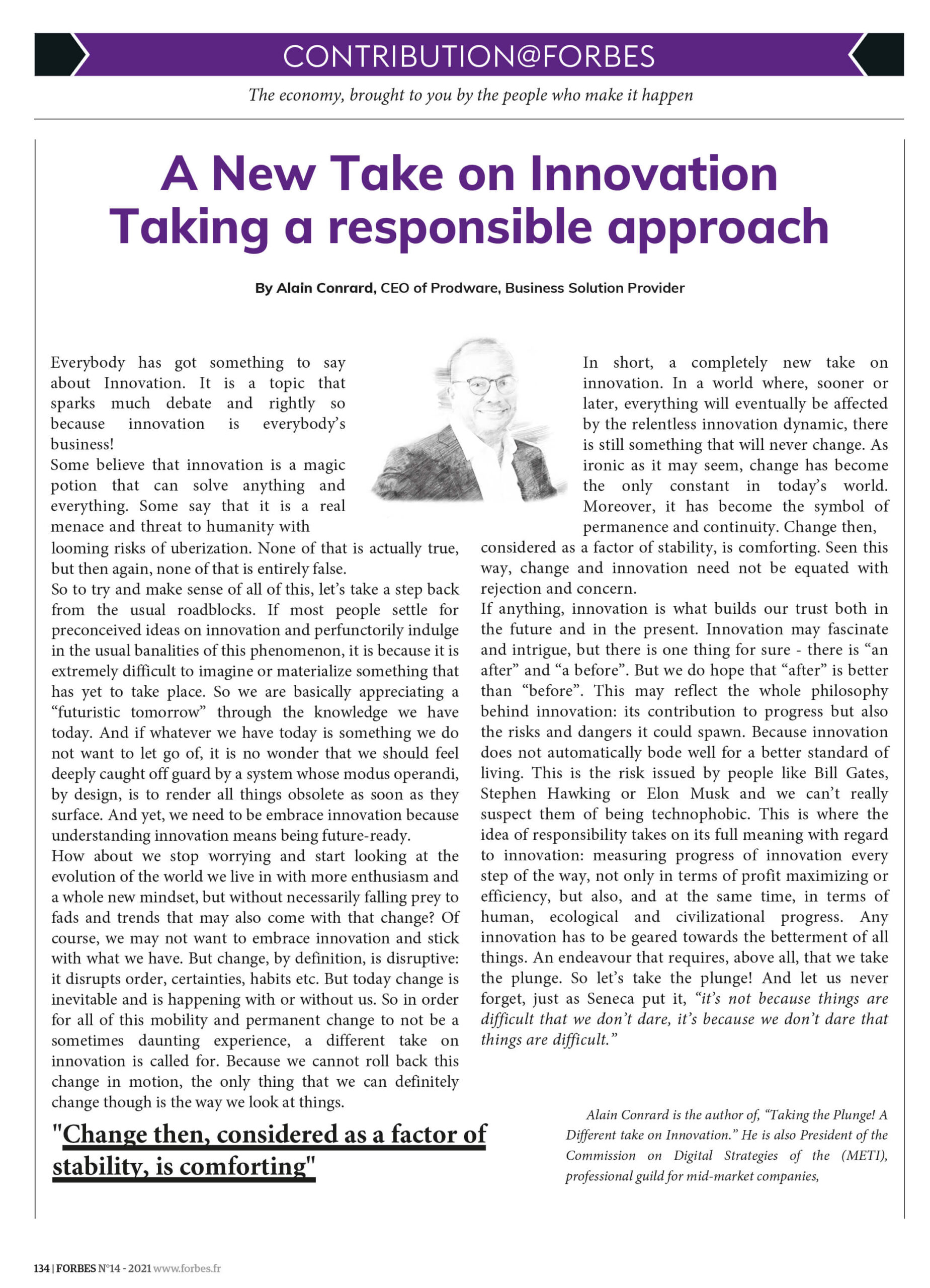
No need to be a genius to innovate – Alain Conrard in EcoRéseau Business
Article published in French news site EcoRéseau Business by Alain Conrard, Prodware CEO
This digital-ready world has opened up avenues in the different ways we tackle our jobs everyday and in the number of choices and decisions we need to make.
To many of us, the expression « the world of tomorrow » is like a wake up call entertaining the idea that we need to rethink the way we live, work and communicate. Living in a highly centralized country and therefore expecting to get orders from above on what to do next, hasn’t prevented the French, from all walks of life, to share their opinions openly but without ever coming up with a vision or serious alternative that could help in reconsidering the situation at hand and bring real change to our lives. And who is to blame? Well it is not their creativity that is to blame nor their wherewithal but more this widespread idea or belief that there is this divide between an “elite or select” group on the one hand and the masses, the plebs on the other hand. This dichotomy has disheartened the masses leading them to believe they have no say or can take no part in driving that change. Napoleon, however did leave his mark in history as did Ferdinand de Lesseps with the Suez Canal, or Blaise Pascal, Curie, Pasteur…they all have contributed to mankind in their respective fields. Yes, many French have distinguished themselves in the fields of Science or Technology, but we tend to believe that these contributions are strictly remote idealized representations, like biblical narratives, when in actual fact, there are incredible inventions that crop up each year in this country – the development of the Start-up nation French style is a testament to all this creativity. But let’s stop thinking that we necessarily need to be data scientists to understand the world we live in today and do our part to change it. And far too often, it doesn’t occur to the French people that they too can be part of this whole innovation dynamic!
Innovating is like taking up brain fitness. People like Marc Simoncini have managed to launch not one or two but three or even four very successful projects! The founder of Meetic has also created Multimania, Sensee and several other companies. Mr. Xavier Niel is another example with his École 42 and Station F that are impressive creations as well. These many initiatives show how disruptive approaches can apply to many different kinds of projects. Others need to take up the mantle and pursue this innovation spree and find ways to innovate and invent new ways of doing things and take an active part in shaping the “world of tomorrow.” After all, isn’t being innovative staying ahead of the game instead of lagging behind and following a trend initiated by others?
Innovation simply means improvement
Thanks to such widespread dissemination of powerful applications, digital technologies and learning resources, gaining access to knowledge has become an obstacle-free course. It is time for our fellow citizens to realize that innovation is everybody’s business and not earmarked only for geniuses. They can innovate too…as long as they bear in mind what innovation entails. Everybody’s got an opinion on the subject but who really knows what it really means?
This is in part why I decided to write Taking the Plunge! A Different Take on Innovation. It is to explain to the wider public what it means to innovate. I explain for instance the difference between “innovating” and “inventing” or “creating.” In all modesty, what I did was to go through all the successful endeavours and comment on them.
For example, if one objectively analyzes the success stories of the GAFAM heavyweights, we realize that Apple for instance, that incredible success story, boasting a 100 billion dollar turnover and reaching more than 2,000 billion dollars in market capitalization, did not invent, oddly enough, what made it so successful in the first place as is too often believed. The American company invented neither the microcomputer (developed by R2E, a French company), nor the MP3 player (launched by the Korean Mpman), nor the smartphone (an IBM invention as early as 1992), nor the tablet (credit goes to Grid Systems, founded by a former Xerox employee). However, what Apple did create is a remarkable innovative approach and that is how they went ahead and designed the Macintosh, leveraging Xerox’s graphic interface. Being innovative does not necessarily call for being a genius inventor but rather coming up with those creative assets that will “reinvent” an existing product replacing it with new features, a new design or other options.
For having been at the helm of Prodware for more than two decades, a group specialized in digital transformation, I have come to understand that innovation is above all a people-related endeavour and that you cannot innovate without people.
More and more people are embracing digital technology and making it their own – and the spread and magnitude of the pandemic has made it easier for everyone to take a more active part in the innovation dynamic. Moreover, the global scale of the covid-19 crisis has acted as a magnifying glass, clearly bringing to the surface the flaws and weaknesses of our societies and economies. And all these new digital technologies have come to the rescue of many industries providing the solutions to address, work through or overcome these challenges and roadblocks.
A new skill & capability landscape
The boundaries between many fields have become blurry and fickle. Innovation has ripped through the traditional barriers and different domains once very distinct are now overlapping. Where, for example, production and services were very different in nature and required completely separate and dedicated skill sets and organizations, are now increasingly coming together as a more comprehensive and broader entity. As a consequence, quality of service has sky rocketed, overall business has soared and we also see a sharp decline in job strain. The IoT, AI, Machine Learning, Augmented Reality, Virtual Reality and the Cloud are the keys to this new skill and capability landscape driving the emergence of new service concepts. Let’s take the example of the elevator self-diagnostic system that measures wear & tear. By accessing and processing data and statistics from the same model elevators around the world, they can actually anticipate a potential breakdown and automatically send a maintenance technician way before the elevator breaks down. That means, in most cases, avoiding costly and crippling downtime.
Now that men and women have gotten rid of all those tedious and automatic tasks, they can now concentrate on issues that involve a more human and relational implication. This whole new world opening up and enabled by the digital revolution makes daily work much more interesting, bringing men and women to draw on their intellectual faculties demanding more analysis and decision making on their part.
This is why the implications of digital transformation must be explained over and over again – in order to mitigate the risks and get the best out of what it can offer. Believing that the world of tomorrow will be run by algorithms is misleading; there is always someone sitting behind a computer looking up information. But how can we make sure that researching data is intended to contribute to the greater good of all and not used to the detriment of society? That is the question. I think it is possible to oversee and be on top of these developments.
But with power also comes responsibility. Indeed, we can’t ignore the risks involved if we let it go unchecked and develop into something dangerous and out of control. We need to appreciate innovation in a new light: we need to realize that innovation is a reliable partner but that it nevertheless cannot be left to play out on its own. It must be embraced with confidence but without blissful optimism or unproductive skepticism. We must know where to draw the line between what innovation can do and what we want it to do. This is a subject in its own right that must be made part of the education system as soon as possible. There is no doubt in my mind that we should touch on innovation starting at school and doing so through both: 1/teaching it in class (middle schools, high schools) and 2/through associations. But then we will have to take the plunge and innovate! And we can afford to be highly optimistic because “innovation is not the prerogative of geniuses, so…”
Imagining New Frontiers – Alain Conrard in La Tribune
Article published in French news site La Tribune by Alain Conrard, Prodware CEO
Like in all crises, the one we are going through compels us to reconsider many things. But the magnitude of this one, like very few crises before it, demands we rethink the global dynamic of our activities.
The global scale and nature of the Covid-19 revealed and highlighted the flaws of our societies and/or economies. And the new technologies spurred by the digital dynamic have definitely contributed in addressing and solving the many challenges, problems or dead ends in many areas.
The situation has brought these emerging technologies to the fore as the driving force in overcoming the crisis, or at least initially as the means to tackle the crisis head on.
Inventing the future, inventing the world of tomorrow
“Coping with,” means that things are set up to ensure business continuity and that society does not come to a stop. But, from a more high-level point of view, this all means reinventing the future. The incredible leap forward enabled by remote working to comply with social distancing requirements for instance, has completely reshuffled the cards for companies upsetting the usual “work at the office” standard to favor virtual business activity. This trend has unequivocally opened up a new growing trend – suffice it to say an overpowering trend in most industries. Online services outdistancing by far the traditional service offerings with on site face-to-face service (both in the workplace but also in stores for example).
The crisis has triggered a global sense of awareness with people all over the world heeding the call of radical change. It has demonstrated to all, in no uncertain terms, the crucial role of innovation. Innovation is clearly the solution though as we are faced with having to reinvent many things: i.e. we need to innovate. And if innovation does sit well with the crisis it is because it is, by design, a system in itself that calls into question all of our certainties, disrupts the status quo, revolutionizes practices replacing them with better-performing processes and new practices: in short it changes things.
Innovation, even before the crisis hit, seems like the only alternative to invent the world of tomorrow. A smarter, more reliable, more sustainable and free-flowing world.
Innovation: a new take on “crossing boundaries”
Innovating often implies reshuffling the traditional pecking order, re-prioritizing, rethinking processes, reconfiguring new schemes and breaking down barriers. In other words, it is all about pushing back the limits. A good innovation slogan could very well be: trailblazing forward in unchartered territory. The general tendency of this momentum is full-out integration, with the integration process playing out by displacing or getting rid of boundaries between areas or fields of expertise that hitherto were completely distinct from one another.
The once siloed domains or fields of expertise significantly overlap and are much more subject to constant change. Innovation resets the boundaries of many areas and brings together domains that never connected before. Production and Services for instance, two organizational setups structured very differently, with each having their own modus operandi, now tend to converge into a global and all-encompassing business unit. The outcome of this evolution is increased quality of service, much better performance standards and alleviating tedious and arduous work. IoT, AI, Machine Learning, Augmented Reality and the Cloud are the key components of this new competence and knowledge-based landscape where technical devices become data emitters, that when processed in real time, enable providing services of a new kind that brings the service offering to a whole new level. Let us look at elevators with a self-diagnostic system that measures wear & tear. Compiling and monitoring the same data and statistics of the same type of elevators worldwide, technicians now get dispatched automatically to service the elevators ahead of time, before they break down, by anticipating eventual glitches. That way we avoid the costly inconveniences of having elevators that are out-of-order. This overlapping phenomenon also determines new approaches in the way we appreciate supply and demand. They are no longer distinct economic models that try, more or less, keeping somewhat of a theoretical and parallel operational balance. The paradigm has been reversed, with the end user now being placed at the heart of the production process as opposed to before, considered only as a basic consumer. The user experience of a product or service (consumer experience) is at the heart of the innovation process. The feedback loops and big data processing cycles allow for “supply” to meet “demand” in real time, dynamically disrupting the traditional designing, manufacturing and distribution processes of products and services.
Innovation can be defined as a global game-changing tool. It encompasses a logic of integration, that of doing away with boundaries including those perceived as impenetrable and unattainable. Innovation, in that sense, is revolutionary.
But innovation is not only about pushing past deep-rooted boundaries. It helps in rethinking the concept of boundaries. Referring to the mythical sense of pioneering beyond a given frontier, innovation is now that frontier: the New frontier. Once replicated exponentially, thanks to the incredible computing capability of today’s digital technologies, we could easily refer to John Kennedy’s famous acceptance speech in 1960 to the innovation phenomenon, providing we include the ecological dimension which is central today, “But the New Frontier of which I speak […], is here whether we seek it or not. Beyond that frontier are uncharted areas of science and space, unsolved problems of peace and war, unconquered problems of ignorance and prejudice, unanswered questions of poverty and surplus.
What is possible and what is impossible
Innovation keeps stretching the limits between what is possible and what is impossible bearing that ever more powerful streak that can reshape the world. This global and powerful dynamic, never before attained by technology in the past, gives it incredible potential to drive economic, social and ecological progress. Industry 4.0 for instance helps set the stage for the re-industrialization or re-localization of Europe so crucial for this continent today.
But with power come responsibilities. There are risk factors related to innovation, if left unchecked, in an uncontrollable and detrimental spree forward that cannot be ignored. A rational and informed approach is called for, one that considers innovation as a boon while not granting it a free pass to run on its own. Innovation needs to be trusted but not met with unchecked optimism or unproductive skepticism. Hence, you need to know where to draw the line with regard to what innovation can encompass and what it cannot. And keeping innovation in check is everybody’s business be it the tech community, the economic players and the world of politics.
When dealing with innovation you therefore need to both get the lay of the land and forge forward into uncharted territory whose boundaries are incessantly moving. And we have to ensure that the complex and often steep development paths it embraces is imbued with a humanistic approach and vision that make sure that, for innovation to bear value and purpose, it has to mandatorily be designed to serve humanity, society and the environment.
Laurent Bigorgne on “Taking the Plunge! A Different Take on Innovation!”
“Innovating is a very humane endeavour”

- Post Date:
Impacts and innovating with a conscience
In his book, Alain Conrard sheds new light on innovation with a global and innovative approach addressing the related concerns caused by this phenomenon.
This approach tackles the many different impacts of innovation, both the positive and negative ones, and sometimes both at the same time. Impacts on our daily lives, on our thought process and on the ecological balance. A new reality that gives innovation a pivotal role and a tremendous transformation dynamic that affects all aspects of society.
With that dynamic and power come responsibility and duty. Innovators need to ensure that they engage in responsible, including socially responsible, innovation initiatives from now on. Alain Conrard is a strong proponent of ethical responsibility when it comes to innovation, a must-have complement to an innovation culture that is still, for a large part, in the making.
Laurent Bigorgne’s point of view
After Jacques Attali (writer and President of Positive Planet), Maurice Levy (Chairman of the Supervisory Board of the Publicis Groupe), Carlo Purassanta (President of Microsoft France), it is now Laurent Bigorgne, Director of the Montaigne Institute, who shares his insights with Alain Conrard on questions related to the impacts, ethical responsibility and the social conscience of innovation.
Innovation affects employment rather radically and directly. Laurent Bigorgne, referring to Schumpeter’s “creative destruction” concept underscores that while innovation destroys jobs because it disrupts everything in its path also creates plenty of new jobs, even if, at first, it is hard to appreciate.
By highlighting the positive impacts of innovation, Laurent Bigorgne explains that he considers the many entrepreneurs or investors he gets to meet, as active contributors to the innovation dynamic rather than passive onlookers.
When talking about data, Laurent Bigorgne makes it a point to show that data is just as much a technical tool as a political one, “Data also means power and domination. It leads to sovereignty.” He puts forward that the power shift brought on by data acquisition and data management should be geared toward fostering progress and serving democracy.
Reacting to Alain Conrard’s statement on the need to not be passive onlookers and his newly coined term “utributor,” Laurent Bigorgne adds that citizens are also very active players through their consumption mode, “there is no stronger force than that of the market : citizens are also consumers.”
Laurent Bigorgne finally discusses the challenges of innovation and ethical responsibility with Alain Conrard, expounding on the Human Being’s place (and limitations) within an ecosystem where the technological advances of machines are ever growing.
The director of the Montaigne Institute concludes this captivating exchange of views with a definition of what the DNA of a great innovator is made of, “A combination of wisdom and audacity that sets the great innovators apart from the rest. There is that crazy and wild streak and also that wisdom because innovating is a very humane endeavour.”
More insights from leading public figures
For the release of Taking the Plunge! A Different Take on Innovation, Alain Conrard and journalist and columnist Eric Revel (LCI, RTL, France Bleu, CNews) talk about the many pivotal issues around innovation with leading public figures.
These captivating and inspiring conversations are broadcast on newtakeoninnovation.com: