
Reindustrializing, Relocating…the Path to Political Innovation?
Article published in French news site La Tribune by Alain Conrard, Prodware CEO
OPINION. Talking about “reindustrializing” and “relocating” is often akin to wishful thinking and is fantasy-like i.e. like going back to a previous status quo. Is it even possible? And if so, is it something we really want to do? By Alain Conrard, CEO of the Prodware Group and President of the Commission on Digital Strategies of the METI (*).
At the end of March 2021, certain images were seen worldwide: those of a pipe that had suddenly been closed off by a valve depicted in a plumbing installation diagram. Except that the pipe in question was the Suez Canal – one of the world’s busiest trade routes – and the valve was a 400-meter long, 220 000-ton container ship that was adrift: that ship was the Ever-Given. The satellite images were striking: they clearly exposed the frailty of globalization. We suddenly realized, in total awe, that 12% of the world’s maritime trade could be disrupted by a closed-off valve. Like a giant clot blocking an essential international trade artery, the mammoth ship, stranded, put the entire distribution of goods circuit at major risk of thrombosis. These times of pandemic also made clear that the economic system was also prone to serious illness; pandemic and shortage could go hand in hand.
The Covid pandemic has brought to the surface certain weaknesses and shortcomings of industrial models related to globalization. The system of dependence on distant suppliers in complex manufacturing and transport chains leads to the loss of control and competitiveness, social dumping, and the sometimes, irreparable destruction of the local industrial landscape.
In order to break away from this dependency overload, or to find alternative solutions, or attempt to balance out a business model, we often hear a lot of talk around the concepts of “reindustrialization” and “relocalization.” Although they do not mean the same thing they are however closely related i.e., how do you go about reindustrializing without relocalizing? How can you rebuild an industrial landscape without setting up local factories or workshops in areas that globalization has systematically deserted? The French government has therefore decided to promote the relocation of production sites in the following five fields considered strategic which are: health, electronics, agri-food, telecoms and industrial inputs.
“RE ?” A New Kind of Mind Mapping
Everything revolves around the meaning of the “RE” prefix in both words. The definition of the prefix suggests “a return to the past”, or the identical repetition of an action that allows us to go over the same points. Talking about « reindustrializing » and « relocating » is often akin to wishful thinking and is fantasy-like i.e. like going back to a previous status quo. But is this even possible? And if so, is it something we really want to do? Can the word suggest a different meaning than that of conveying some sense of nostalgia, looking to the past, reminiscing, deception or impossibility? The identical reproduction of something that the “re” prefix seems to suggest is simply wishful thinking, both from a practical and logical standpoint: when trying to reproduce something of the past, we always introduce something different because we ourselves have changed and the world around us has evolved.
No matter how sorry we feel about this idea, we have to come to terms with the idea that the past is long gone. Reindustrializing as well as relocalizing can, in no way, be achieved by simply going back to the glory days of the past. Reindustrializing consists in fact in adopting completely new ways of industrializing: that of an “RE” that is in fact looking towards the future rather than towards the past – a redeployment of the “RE” prefix. Key in this new industrialization process are digital transformation and innovation. Relocalizing requires a new kind of local/global synergy (innovation can also address social issues, so why only consider technology alone?) How can we reconcile what seems to be incompatible i.e. profitability and local production? Here, too, we need to broaden our appreciation of the notion of “profitability”, which does not only relate to financial gain but also spreads through social, societal and ecological aspects. What comes out of all this is that this program, if it makes sense, can only mean thinking and acting differently.
And so, if Covid has clearly been an accelerator for relocalization, it also has been for change. In the midst of a multitude of disasters, there is at least one positive takeaway: the pandemic has forced us to look at our mistakes, roadblocks and dead ends. It has pushed us forward driving us to reinvent a new future, a new working and living environment. In short, it has compelled us to innovate.
The crisis is causing us to adopt a new mindset especially when it comes to the question of relocalization, when social and ecological benefits of short supply chains is now pretty obvious. The disruptive nature of the solutions that need to be developed to address this global and multi-faceted crisis is absolute. The need to reindustrialize and relocalize raises the question of borders: geographical borders, of course (where should consumer goods be manufactured?), but also political borders (how do you reinstate industrial sovereignty and create value within your own geography?) It is also about rethinking economic models and taking back control of our economy, and doing so through an innovation dynamic. This new mindset means “changing operating systems” to be able to think differently, according to a model that does not fall prey to the demands of globalization.
It even goes as far as considering to withdraw from this dominant economic model. This withdrawal is made possible in fact by the changes brought on by this global crisis and especially by the massive government support worldwide.
Government & Politics, Back in the Business Landscape: the Latest in Innovation
Every power in place has to have a counter-power. With that statement in mind, it is true that letting the world economy run and regulate itself was probably not a great idea in the long run. So politics is easing its way back into the game to help regulate certain economic discrepancies even though, and let’s not be naïve here, that at the end of the day it boils down to, “it’s the economy, stupid” according to James Carville, Bill Clinton’s strategist during his presidential campaign in 1992.
We are witnessing a really important boomerang effect with politics making its great comeback in the economy after 40 years of free capitalism and no state interference following the conservative revolution that brought Ronald Reagan to power in 1981 in the United States.
Up until now, we have been subjected to the macroeconomic effects of globalization, with an overwhelming prevalence of economics in decision-making that has greatly restricted the latitude of political options. Now, the ideological boundary that limits the role of the state to its strict governmental functions is collapsing. The combined effects of the environmental crisis, the social crisis and the health crisis (all three probably being different facets of the same thing) have jammed up, right in front of our eyes, this hitherto well-oiled piece of machinery. And, as if it were waking up from a long sleep, the State is called upon to intervene, urgently and with authority.
Inspired by the New Deal or the Great Society of his predecessors, Roosevelt and Johnson, the 46th American President opened the floodgates of federal funding (let’s not forget that Joe Biden’s middle name is “faucet Joe”). His administration is injecting thousands of billions of dollars into the economy, including an ambitious program of major infrastructure projects – in the term’s broadest sense: roads, widespread access to high-speed Internet, care for the elderly and the disabled, equipment and networks needed for the transition to renewable energy, etc.
In the United States, as in many countries, innovation and digital transformation are set to play a central role in these business redefinition and redeployment processes.
Innovation is based on the idea of doing away with old habits or methods in favor of more efficient means. Innovation is generally the result of a fresh look at things and providing new solutions in terms of technology. Here, the disruption resides in resorting to technological advancements in areas usually oblivious to such considerations: that of government technologies. Government authorities have long been discredited for blindly applying the monetarist and free-trade theories of the Chicago school of thought (Milton Friedman), which inspired most liberal economic policies from the 1980s onwards. Since last year, they have adopted a completely different position throughout the world and are now considered as the ultimate bulwark for containing the pandemic and countering its deleterious effects. The use of government-specific decision-making technologies in economic matters is to be appreciated as a major innovation.
Of course, one cannot expect everything from politics. In no way, should we sit around passively waiting for things to happen – nothing can replace taking action. Everyone has to try, as far as possible, to take their destiny into their own hands. Moreover, as a group, we must be willing to accept the idea that choosing means arbitrating. It means giving up some things for other things. For example, it is more than ever necessary today to join together in committing ourselves to conduct reforms that are absolutely essential in driving more flexibility.
In any case, this decision to have the State back in the driver’s seat and providing it with considerable resources appears to be a welcome leap forward. It is to be applauded as an innovative and modern framework set forth to shape the future. One of its main qualities that this initiative brings is that it fosters optimism and confidence, two notions that are essential for the smooth running of society in general and the economy in particular.
In theory, politics making its way back into the picture, can be one of the ways to help us through this crisis. Why? Because politics, at the end of the day, despite what it draws in terms of criticism and distrust, represents the voice of the people, the voice of the majority. It works toward the general interest of society like no other human initiative. Moreover, a Public Interest Policy has demonstrated more than once in history that it can help in restoring the economy, a fundamental indicator of a healthy society. And so, only strong political will is likely to foster the conditions conducive to a reindustrialization and relocalization dynamic, that can materialize into something socially significant and economically realistic in France and in Europe.
But that political will remains to be seen and needs to be utilized where necessary and applicable. So let’s make room for some political innovation!
Mid-Market Companies at the Heart of This Dynamic
It is becoming perfectly clear today that restoring sovereignty means re-empowering regions and territories in becoming more independent. Indeed, they have a pivotal role in developing and sustaining the economy. And this calls for rethinking the essential role of the entire ecosystem, notably for the mid-market companies in the regional social fabric. Indeed, 68% of company headquarters are located outside the Paris region, and 75% of its production sites are located in medium-sized cities or rural areas. As the largest employer in France (335,000 jobs created between 2009 and 2015), Mid-caps play an important social role. By creating jobs they contribute in keeping those territories alive and kicking.
Thus, beyond their strict economic function, mid-caps contribute in maintaining a safe and secure society conducive to employment and decent living conditions. They are therefore the linchpin of political stability. In this period of very high social unrest, mid-caps are a kind of a crisis extinguisher.
Reviving the country means reviving industry. With their 3.3 million employees, who represent 38% of the jobs in the manufacturing industry, mid-caps are the beating heart of industry in the different regions. In fact, one out of three mid-caps are in the industry sector. Mid-caps are a first-rate army set out to reconquer our economic sovereignty in the Healthcare, Food or Industry sectors.
So, if we intend to go ahead with reindustrializing and relocalizing our industries, we can rely on the network of mid-caps that make up the economic and industrial fabric of our country alongside the other assets also made up of SMEs and large industrial groups. We need to bring together the different market players to find robust and sustainable solutions, those of the real economy.
We have got what it takes to do just that.
We are all driven and eager to make this happen.
We have the know-how, the innovation expertise and industrial wherewithal to do all of this.
No need to play the blame game if ever we do not succeed: the key to our success lies in our own hands.
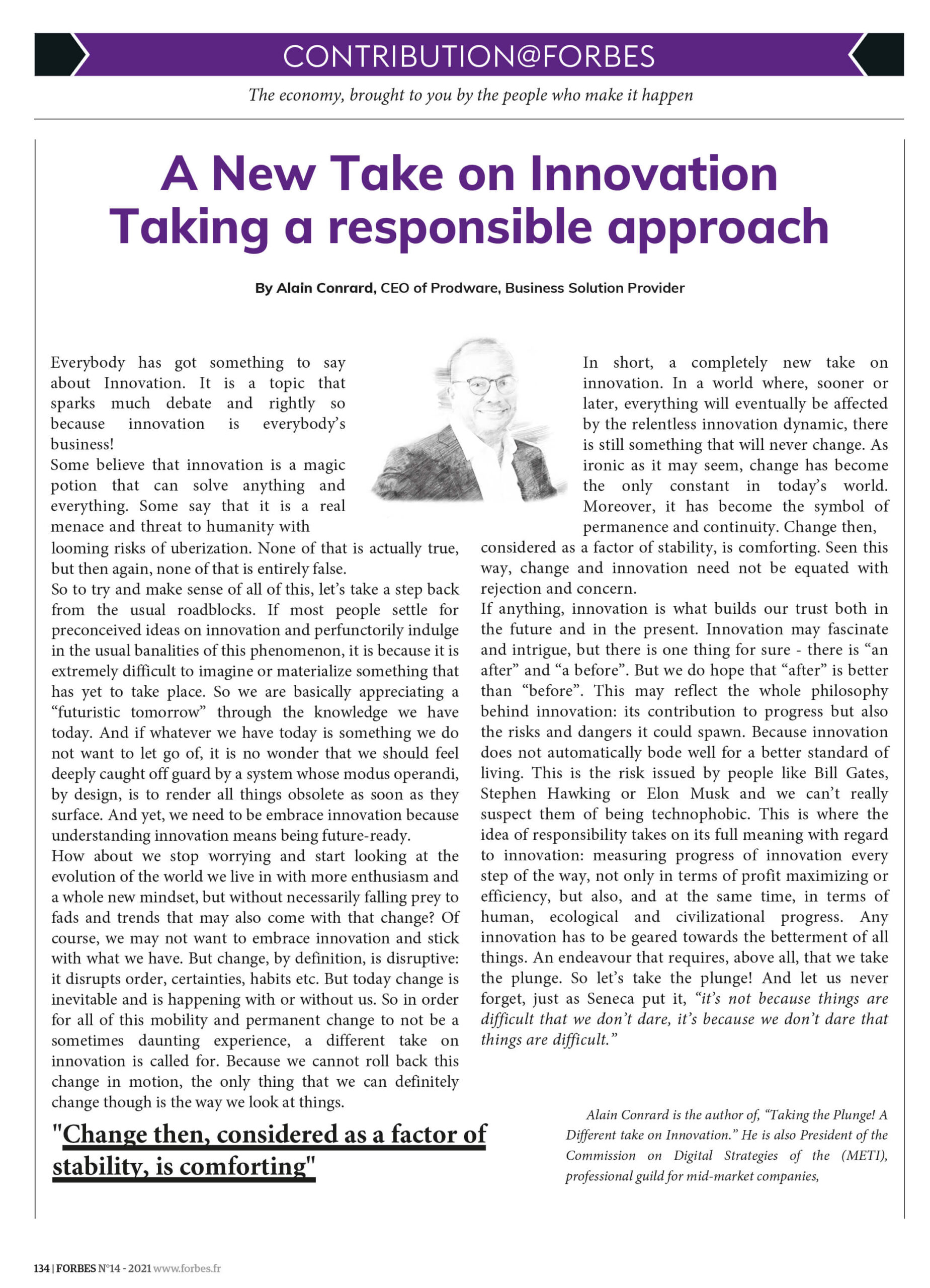
No need to be a genius to innovate – Alain Conrard in EcoRéseau Business
Article published in French news site EcoRéseau Business by Alain Conrard, Prodware CEO
This digital-ready world has opened up avenues in the different ways we tackle our jobs everyday and in the number of choices and decisions we need to make.
To many of us, the expression « the world of tomorrow » is like a wake up call entertaining the idea that we need to rethink the way we live, work and communicate. Living in a highly centralized country and therefore expecting to get orders from above on what to do next, hasn’t prevented the French, from all walks of life, to share their opinions openly but without ever coming up with a vision or serious alternative that could help in reconsidering the situation at hand and bring real change to our lives. And who is to blame? Well it is not their creativity that is to blame nor their wherewithal but more this widespread idea or belief that there is this divide between an “elite or select” group on the one hand and the masses, the plebs on the other hand. This dichotomy has disheartened the masses leading them to believe they have no say or can take no part in driving that change. Napoleon, however did leave his mark in history as did Ferdinand de Lesseps with the Suez Canal, or Blaise Pascal, Curie, Pasteur…they all have contributed to mankind in their respective fields. Yes, many French have distinguished themselves in the fields of Science or Technology, but we tend to believe that these contributions are strictly remote idealized representations, like biblical narratives, when in actual fact, there are incredible inventions that crop up each year in this country – the development of the Start-up nation French style is a testament to all this creativity. But let’s stop thinking that we necessarily need to be data scientists to understand the world we live in today and do our part to change it. And far too often, it doesn’t occur to the French people that they too can be part of this whole innovation dynamic!
Innovating is like taking up brain fitness. People like Marc Simoncini have managed to launch not one or two but three or even four very successful projects! The founder of Meetic has also created Multimania, Sensee and several other companies. Mr. Xavier Niel is another example with his École 42 and Station F that are impressive creations as well. These many initiatives show how disruptive approaches can apply to many different kinds of projects. Others need to take up the mantle and pursue this innovation spree and find ways to innovate and invent new ways of doing things and take an active part in shaping the “world of tomorrow.” After all, isn’t being innovative staying ahead of the game instead of lagging behind and following a trend initiated by others?
Innovation simply means improvement
Thanks to such widespread dissemination of powerful applications, digital technologies and learning resources, gaining access to knowledge has become an obstacle-free course. It is time for our fellow citizens to realize that innovation is everybody’s business and not earmarked only for geniuses. They can innovate too…as long as they bear in mind what innovation entails. Everybody’s got an opinion on the subject but who really knows what it really means?
This is in part why I decided to write Taking the Plunge! A Different Take on Innovation. It is to explain to the wider public what it means to innovate. I explain for instance the difference between “innovating” and “inventing” or “creating.” In all modesty, what I did was to go through all the successful endeavours and comment on them.
For example, if one objectively analyzes the success stories of the GAFAM heavyweights, we realize that Apple for instance, that incredible success story, boasting a 100 billion dollar turnover and reaching more than 2,000 billion dollars in market capitalization, did not invent, oddly enough, what made it so successful in the first place as is too often believed. The American company invented neither the microcomputer (developed by R2E, a French company), nor the MP3 player (launched by the Korean Mpman), nor the smartphone (an IBM invention as early as 1992), nor the tablet (credit goes to Grid Systems, founded by a former Xerox employee). However, what Apple did create is a remarkable innovative approach and that is how they went ahead and designed the Macintosh, leveraging Xerox’s graphic interface. Being innovative does not necessarily call for being a genius inventor but rather coming up with those creative assets that will “reinvent” an existing product replacing it with new features, a new design or other options.
For having been at the helm of Prodware for more than two decades, a group specialized in digital transformation, I have come to understand that innovation is above all a people-related endeavour and that you cannot innovate without people.
More and more people are embracing digital technology and making it their own – and the spread and magnitude of the pandemic has made it easier for everyone to take a more active part in the innovation dynamic. Moreover, the global scale of the covid-19 crisis has acted as a magnifying glass, clearly bringing to the surface the flaws and weaknesses of our societies and economies. And all these new digital technologies have come to the rescue of many industries providing the solutions to address, work through or overcome these challenges and roadblocks.
A new skill & capability landscape
The boundaries between many fields have become blurry and fickle. Innovation has ripped through the traditional barriers and different domains once very distinct are now overlapping. Where, for example, production and services were very different in nature and required completely separate and dedicated skill sets and organizations, are now increasingly coming together as a more comprehensive and broader entity. As a consequence, quality of service has sky rocketed, overall business has soared and we also see a sharp decline in job strain. The IoT, AI, Machine Learning, Augmented Reality, Virtual Reality and the Cloud are the keys to this new skill and capability landscape driving the emergence of new service concepts. Let’s take the example of the elevator self-diagnostic system that measures wear & tear. By accessing and processing data and statistics from the same model elevators around the world, they can actually anticipate a potential breakdown and automatically send a maintenance technician way before the elevator breaks down. That means, in most cases, avoiding costly and crippling downtime.
Now that men and women have gotten rid of all those tedious and automatic tasks, they can now concentrate on issues that involve a more human and relational implication. This whole new world opening up and enabled by the digital revolution makes daily work much more interesting, bringing men and women to draw on their intellectual faculties demanding more analysis and decision making on their part.
This is why the implications of digital transformation must be explained over and over again – in order to mitigate the risks and get the best out of what it can offer. Believing that the world of tomorrow will be run by algorithms is misleading; there is always someone sitting behind a computer looking up information. But how can we make sure that researching data is intended to contribute to the greater good of all and not used to the detriment of society? That is the question. I think it is possible to oversee and be on top of these developments.
But with power also comes responsibility. Indeed, we can’t ignore the risks involved if we let it go unchecked and develop into something dangerous and out of control. We need to appreciate innovation in a new light: we need to realize that innovation is a reliable partner but that it nevertheless cannot be left to play out on its own. It must be embraced with confidence but without blissful optimism or unproductive skepticism. We must know where to draw the line between what innovation can do and what we want it to do. This is a subject in its own right that must be made part of the education system as soon as possible. There is no doubt in my mind that we should touch on innovation starting at school and doing so through both: 1/teaching it in class (middle schools, high schools) and 2/through associations. But then we will have to take the plunge and innovate! And we can afford to be highly optimistic because “innovation is not the prerogative of geniuses, so…”
Imagining New Frontiers – Alain Conrard in La Tribune
Article published in French news site La Tribune by Alain Conrard, Prodware CEO
Like in all crises, the one we are going through compels us to reconsider many things. But the magnitude of this one, like very few crises before it, demands we rethink the global dynamic of our activities.
The global scale and nature of the Covid-19 revealed and highlighted the flaws of our societies and/or economies. And the new technologies spurred by the digital dynamic have definitely contributed in addressing and solving the many challenges, problems or dead ends in many areas.
The situation has brought these emerging technologies to the fore as the driving force in overcoming the crisis, or at least initially as the means to tackle the crisis head on.
Inventing the future, inventing the world of tomorrow
“Coping with,” means that things are set up to ensure business continuity and that society does not come to a stop. But, from a more high-level point of view, this all means reinventing the future. The incredible leap forward enabled by remote working to comply with social distancing requirements for instance, has completely reshuffled the cards for companies upsetting the usual “work at the office” standard to favor virtual business activity. This trend has unequivocally opened up a new growing trend – suffice it to say an overpowering trend in most industries. Online services outdistancing by far the traditional service offerings with on site face-to-face service (both in the workplace but also in stores for example).
The crisis has triggered a global sense of awareness with people all over the world heeding the call of radical change. It has demonstrated to all, in no uncertain terms, the crucial role of innovation. Innovation is clearly the solution though as we are faced with having to reinvent many things: i.e. we need to innovate. And if innovation does sit well with the crisis it is because it is, by design, a system in itself that calls into question all of our certainties, disrupts the status quo, revolutionizes practices replacing them with better-performing processes and new practices: in short it changes things.
Innovation, even before the crisis hit, seems like the only alternative to invent the world of tomorrow. A smarter, more reliable, more sustainable and free-flowing world.
Innovation: a new take on “crossing boundaries”
Innovating often implies reshuffling the traditional pecking order, re-prioritizing, rethinking processes, reconfiguring new schemes and breaking down barriers. In other words, it is all about pushing back the limits. A good innovation slogan could very well be: trailblazing forward in unchartered territory. The general tendency of this momentum is full-out integration, with the integration process playing out by displacing or getting rid of boundaries between areas or fields of expertise that hitherto were completely distinct from one another.
The once siloed domains or fields of expertise significantly overlap and are much more subject to constant change. Innovation resets the boundaries of many areas and brings together domains that never connected before. Production and Services for instance, two organizational setups structured very differently, with each having their own modus operandi, now tend to converge into a global and all-encompassing business unit. The outcome of this evolution is increased quality of service, much better performance standards and alleviating tedious and arduous work. IoT, AI, Machine Learning, Augmented Reality and the Cloud are the key components of this new competence and knowledge-based landscape where technical devices become data emitters, that when processed in real time, enable providing services of a new kind that brings the service offering to a whole new level. Let us look at elevators with a self-diagnostic system that measures wear & tear. Compiling and monitoring the same data and statistics of the same type of elevators worldwide, technicians now get dispatched automatically to service the elevators ahead of time, before they break down, by anticipating eventual glitches. That way we avoid the costly inconveniences of having elevators that are out-of-order. This overlapping phenomenon also determines new approaches in the way we appreciate supply and demand. They are no longer distinct economic models that try, more or less, keeping somewhat of a theoretical and parallel operational balance. The paradigm has been reversed, with the end user now being placed at the heart of the production process as opposed to before, considered only as a basic consumer. The user experience of a product or service (consumer experience) is at the heart of the innovation process. The feedback loops and big data processing cycles allow for “supply” to meet “demand” in real time, dynamically disrupting the traditional designing, manufacturing and distribution processes of products and services.
Innovation can be defined as a global game-changing tool. It encompasses a logic of integration, that of doing away with boundaries including those perceived as impenetrable and unattainable. Innovation, in that sense, is revolutionary.
But innovation is not only about pushing past deep-rooted boundaries. It helps in rethinking the concept of boundaries. Referring to the mythical sense of pioneering beyond a given frontier, innovation is now that frontier: the New frontier. Once replicated exponentially, thanks to the incredible computing capability of today’s digital technologies, we could easily refer to John Kennedy’s famous acceptance speech in 1960 to the innovation phenomenon, providing we include the ecological dimension which is central today, “But the New Frontier of which I speak […], is here whether we seek it or not. Beyond that frontier are uncharted areas of science and space, unsolved problems of peace and war, unconquered problems of ignorance and prejudice, unanswered questions of poverty and surplus.
What is possible and what is impossible
Innovation keeps stretching the limits between what is possible and what is impossible bearing that ever more powerful streak that can reshape the world. This global and powerful dynamic, never before attained by technology in the past, gives it incredible potential to drive economic, social and ecological progress. Industry 4.0 for instance helps set the stage for the re-industrialization or re-localization of Europe so crucial for this continent today.
But with power come responsibilities. There are risk factors related to innovation, if left unchecked, in an uncontrollable and detrimental spree forward that cannot be ignored. A rational and informed approach is called for, one that considers innovation as a boon while not granting it a free pass to run on its own. Innovation needs to be trusted but not met with unchecked optimism or unproductive skepticism. Hence, you need to know where to draw the line with regard to what innovation can encompass and what it cannot. And keeping innovation in check is everybody’s business be it the tech community, the economic players and the world of politics.
When dealing with innovation you therefore need to both get the lay of the land and forge forward into uncharted territory whose boundaries are incessantly moving. And we have to ensure that the complex and often steep development paths it embraces is imbued with a humanistic approach and vision that make sure that, for innovation to bear value and purpose, it has to mandatorily be designed to serve humanity, society and the environment.